Medicover views environmental care as a prerequisite for human health and wellbeing. Medicover is committed to play its part in the achievement of SDG #13: Take urgent action to combat climate change and its impacts by for instance reducing greenhouse gas emissions. Improving access to care means that Medicover’s investments are directed mainly to markets where the current healthcare access remains limited. These markets are often still heavily reliant on fossil fuels, which is reflected in the current profile of Medicover’s CO2e emissions.
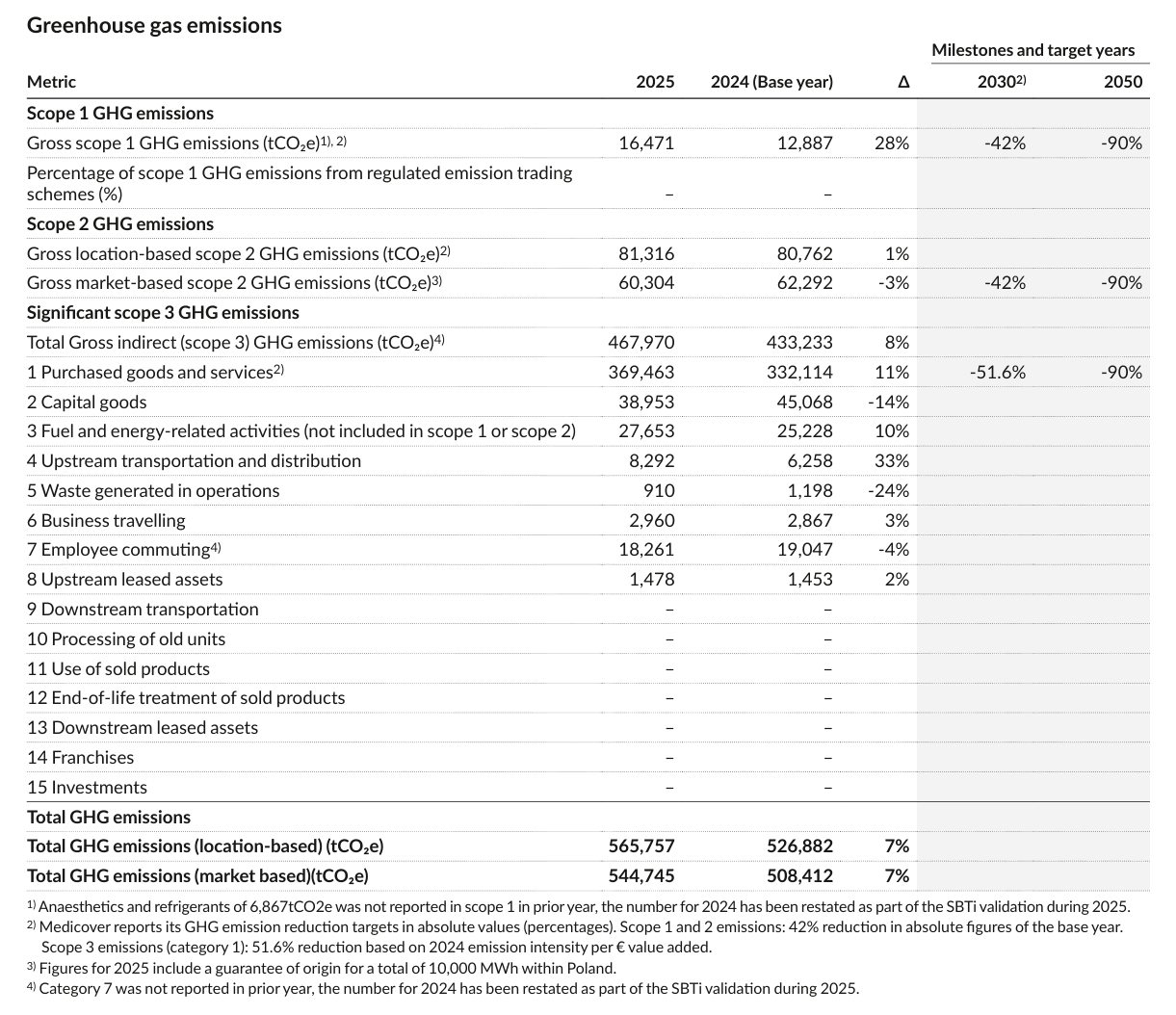
Medicover strives to decrease the Company’s environmental impact over time. Medicover’s main environmental impacts and risks are related to energy use in its hospitals, clinics and other facilities; from various equipment and materials; from external and internal transport; and from waste. Medicover aims to reduce absolute scope 1 and 2 GHG emissions 42% by 2030 and 90% by 2050, from a 2024 base year.
In 2025 the Medicover Environmental and Climate Change Policy was updated as part of an ongoing assessment to improve environmental performance. The policy is aligned with the Paris Agreement and commits Medicover to:
- Conduct all activities in compliance with relevant environmental legislation and regulations in the countries in which Medicover operates.
- Consider opportunities and risks from an environmental perspective when making business decisions.
- Monitor, measure and seek to reduce greenhouse gas emissions from its own operations.
- Follow a sustainable energy model/strategy based on efficiency and the use of renewable energy sources where available.
- Optimise distribution and logistics processes to make them more environmentally friendly.
- Manage natural resources responsibly and sustainably.
- Improve water management and efficiency in buildings.
- Apply measures to prevent and reduce pollution across air, water, soil, living organisms and food resources.
- Progressively transition to a circular economy by maximising resources utilisation, minimising waste generation, strengthen recycling practices and enhance the use of recyclable materials.
- Develop digital solutions and services with lower environmental impact.
- Consider and progressively implement Environmental Management Systems which may be certified in accordance with ISO 14001 or EMAS.
- Consider and seek to minimise the indirect environmental impact of Medicover throughout its value chain.
- Engage with affected stakeholders to minimise any harmful impacts.
Progress is measured by tracking:
- Medicover’s total GHG intensity emissions per net revenue: 241 tCO2e (location-based) and 232 tCO2e (market-based) per EURm of revenue.
- Medicover’s total GHG emissions: 565,757 tCO2e (location-based) and 544,745 tCO2e (market-based).
Below table summarises Medicover's key environmental indicators and covers all operations.